From seawater to drinking water, and the latest water technology.
A sourced guide to how desalination works, the plants that lead it, and a reading list of new water technology and research that updates every day.
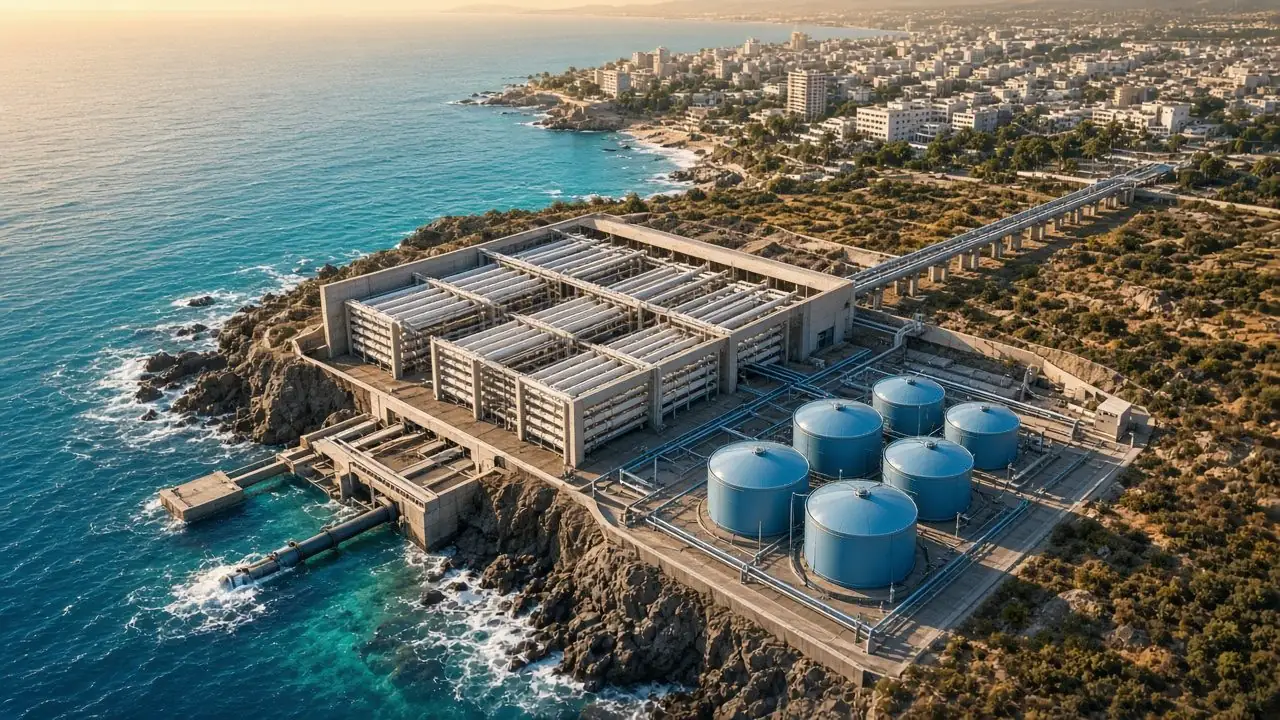
Seawater to drinking water: how it works
Thermal vs membrane desalination
Thermal plants such as multi-effect distillation (MED) evaporate and condense seawater and suit sites with waste heat, such as refineries (IDE, Jamnagar). Most new large drinking-water plants use seawater reverse osmosis (SWRO), which pushes seawater through membranes at high pressure. Israel's Sorek and Chennai's plants are SWRO.
Pre-treatment
Seawater is filtered before it reaches the membranes to stop fouling. At Sorek 2, IDE uses single-stage dual-media gravity filters operated as biofilters, followed by 20-micron cartridge filters, with almost no filter chemicals (Water Desalination Report).
Energy recovery
The brine leaving the membranes is still at high pressure. Pressure exchangers pass that pressure straight back to incoming seawater at around 96% efficiency, versus about 74% through a Pelton turbine chain (Texas Water Development Board).
Energy use
A complete SWRO plant uses roughly 3.9 to 5.6 kWh per m³, depending on water temperature, pre-treatment and energy recovery (Desalination and Water Treatment). Retrofitting energy recovery has cut plant energy use, for example from 6.7 to 4.1 kWh/m³ at Las Palmas III (IWA Publishing).
Remineralisation
RO water is almost mineral-free, so minerals are added back before supply to make it stable and palatable. Sorek 2 captures CO₂ from its power plant and reuses it in remineralisation (WDR).
Brine management
Concentrated brine goes back to sea through long outfalls with diffusers to spread it; Sorek uses multi-diffuser outfalls built by pipe-jacking to avoid seabed and shoreline damage (IDE).
Notable plants
- Sorek 1, Israel: 624,000 m³/day SWRO, commissioned 2013 (IDE).
- Sorek 2, Israel: 672,000 m³/day installed SWRO, delivered under a 25-year BOT contract for the State of Israel (IDE).
- Minjur, Chennai: 100 MLD SWRO, commissioned 2010; it draws 237 MLD of seawater to make 100 MLD (CMWSSB). Reported under renovation in 2026 (DT Next).
- Nemmeli, Chennai: 100 MLD plant commissioned 2013, and a 150 MLD plant opened in February 2024 to serve about 9 lakh residents (BusinessLine).
- Perur, Chennai: 400 MLD plant under construction; expected commissioning October 2027 (DT Next).
Latest water technology & research
Headlines on desalination, water treatment and water reuse from public news and journal feeds, refreshed daily.
The Nation (Pakistan ) · 31 Oct 2026
CM Murad invites Portuguese firms to invest in Karachi’s water desalination, energy sector
Mobility Plaza · 31 Oct 2026
Sonny’s to distribute Moleaer nanobubble water treatment to U.S. car washes
The News Pakistan · 31 Oct 2026
Sindh, Portugal agree to explore cooperation in desalination, energy
Ocean News & Technology · 30 Oct 2026
NOV Subsea Technologies Lands Two Gulf Energy Information Excellence Awards
ScienceDaily · 30 Oct 2026
The asteroid killed the dinosaurs. Why did crocodiles survive?
Indian Council Of Agricultural Research · 30 Oct 2026
ICAR-IIHR’s Hot Water Technology to boost the export of South Indian Mangoes
ScienceDaily · 30 Oct 2026
Scientists confirm global warming is accelerating faster than ever recorded
bioengineer.org · 30 Oct 2026
Solar-Powered Membrane Distillation Moves Closer to Real-World Desalination
Sada Elbalad English · 29 Oct 2026
Egypt, Rosatom Discuss Integrated Desalination Project
Construction World India · 29 Oct 2026
WABAG Secures Mega Order from Reliance Industries for Jamnagar Plants
Egyptian Gazette · 28 Oct 2026
Egypt, Spain strengthen strategic links in water desalination
ScienceDaily · 28 Oct 2026
Scientists discover a hidden 100-million-year-old volcanic system
Wastewater Digest · 28 Oct 2026
What is water reuse and reclamation?
ScienceDaily · 28 Oct 2026
Earth's ice ages may have been driven by a hidden ocean chain reaction
Smart Water Magazine · 28 Oct 2026
EPA unveils PFAS TECH strategy to pilot PFAS treatment and destruction technologies
ScienceDaily · 28 Oct 2026
Antarctica’s “Doomsday Glacier” could raise sea levels twice as much as predicted
San Antonio Express-News · 28 Oct 2026
Texas could end up paying an Israeli company billions of dollars for water
Inside Climate News · 28 Oct 2026
How Texas Could End Up Paying an Israeli Company Billions for Water
WaterWorld · 28 Oct 2026
EPA launches strategy to advance PFAS treatment and destruction technologies
npj Clean Water (Nature) · 28 Oct 2026
Engineered biofilms as compartments regulating PFAS fate in water and wastewater treatment
Egyptian Gazette · 27 Oct 2026
AOI showcases locally manufactured water technologies at IWWI 2026
Headlines via Google News, ScienceDaily and Nature (npj Clean Water) public feeds. Content belongs to the respective publishers; links open the publisher's site. Listing a headline does not imply any affiliation with, or endorsement by, the publisher or any organisation mentioned.
Frequently asked questions
Planning an RO or desalination project?
Free consultation by email: send us your requirement and a senior consultant replies within 1 business day.
